Convenience becomes infrastructure. Then it stops being a choice.
A prognostic novel by Mila Agius. Pattern recognition, not prediction.
You are viewing restricted materials. Access priority: low. Recordings will be preserved.
The model in operation.
Your past, recalculated. One ticked box, and the system holds authority over what you have already done.
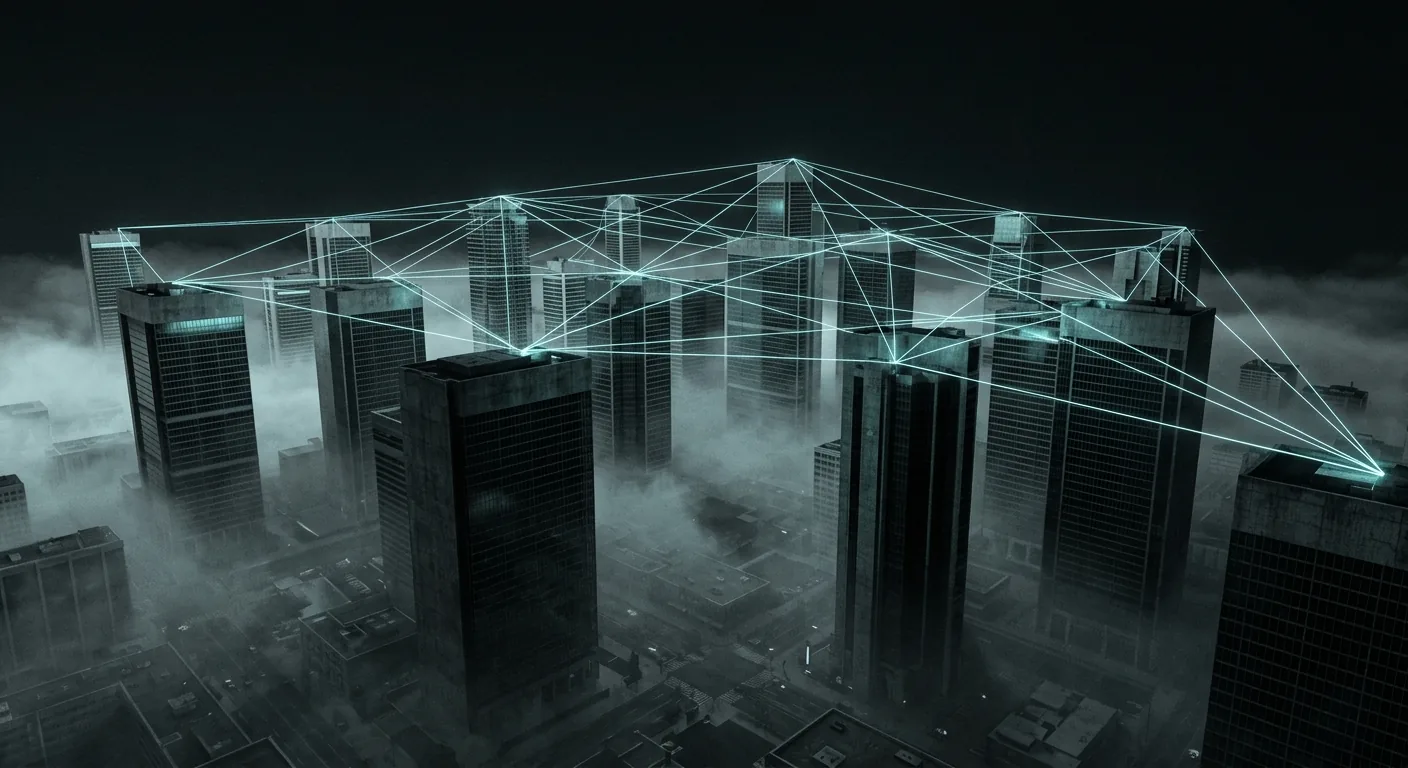
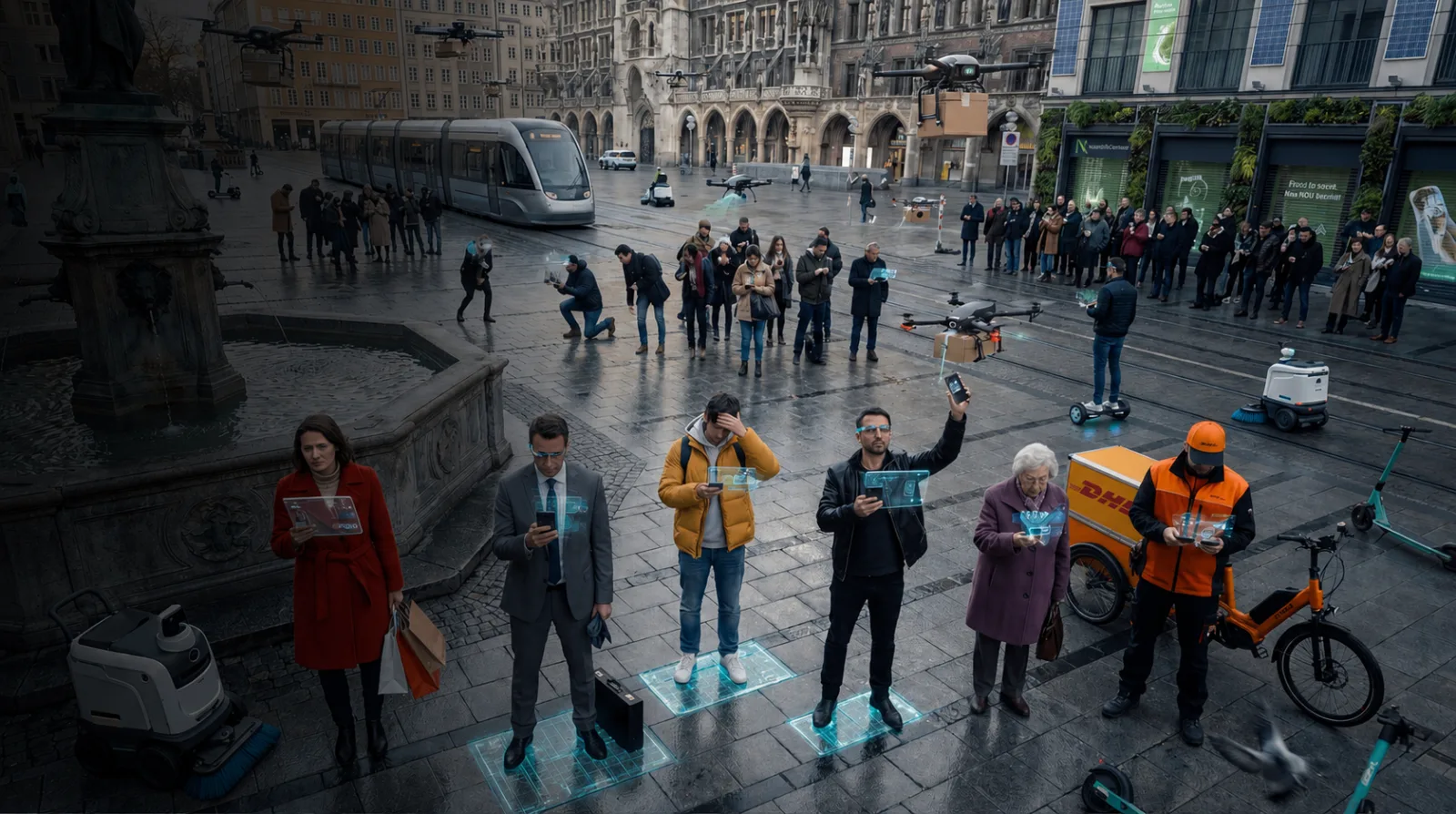
Surveillance node #MUC-821
Every action of the observer is evaluated instantly. The Payment Integrity Graph maps spending metadata against the geolocated risk profile of the sector.
Yesterday you paid twelve euros. Today, "Economic Responsibility Day" has been declared. Your past has been recalculated. This is legal, because you once ticked a box. Welcome to 2040. The model.
Subject exposed to corrective transaction data. Compliance score adjusted. Continued exposure logged.
012040 is not science fiction. It is a model of the near future, built from regulatory documents, policy papers and technical specifications that already exist in 2026. Every core mechanism in the book, retroactive corrections, the Payment Integrity Graph, programmable money, the staged elimination of cash, has a recognizable prototype, precedent, or partial infrastructure today. The novel does not invent the architecture. It only completes it.
02Behind the narrative is a behavioural psychologist working in the Gigerenzer school. The book maps how three weaponized heuristics, trust in authority, follow the majority, fear of loss, convert convenience into infrastructure, and infrastructure into something you can no longer step outside of. It is pattern recognition, not prediction.
03The book is the entry point. Eight chapters are published serially on Substack. The crowdfunding funds the completion of the remaining eight and the release of the full sixteen-chapter book.
Where Orwell placed dystopia in the totalitarian state, Foucault located it in the quiet architectures of surveillance and scoring. 2040 follows the same trajectory into payment infrastructure: total control achieved not through violence, but through the cumulative weight of reasonable directives, each one framed as protection.
Subject is accessing materials marked PROGNOSTIC. Reading pattern flagged for extended monitoring.
The thesis, in three moves.
No coercion is required. Three ordinary shortcuts of human judgement, each turned against the person using it. Select one to open it.
Subject is reviewing its own decision architecture. Self-awareness logged as a moderate risk factor.
The book is the first stage. What follows is the readers' problem.
Sixteen chapters. Eight published, eight in draft. The campaign also opens the next stage of the project.
The work does not conclude with publication. What follows is the gradual assembly of readers who treat the mechanisms described in 2040 as operational problems requiring new mechanisms of choice: lawful tools, financial pathways, and practical structures that already exist in different countries, but remain invisible to most people.
The book functions as the initial filter through which this cohort begins to identify itself and its position relative to the systems mapped.
- 01 Completion of chapters 9 to 16, currently in draft.
- 02 Full editorial pass and production across all sixteen chapters.
- 03 Cover, typography, and distribution to backers and retail channels.
Get notified at launch
One notification only. No further correspondence.
Redirects to Kickstarter. The transaction occurs outside the observation environment.
Subject has registered intent to receive launch notification. Pattern recorded.

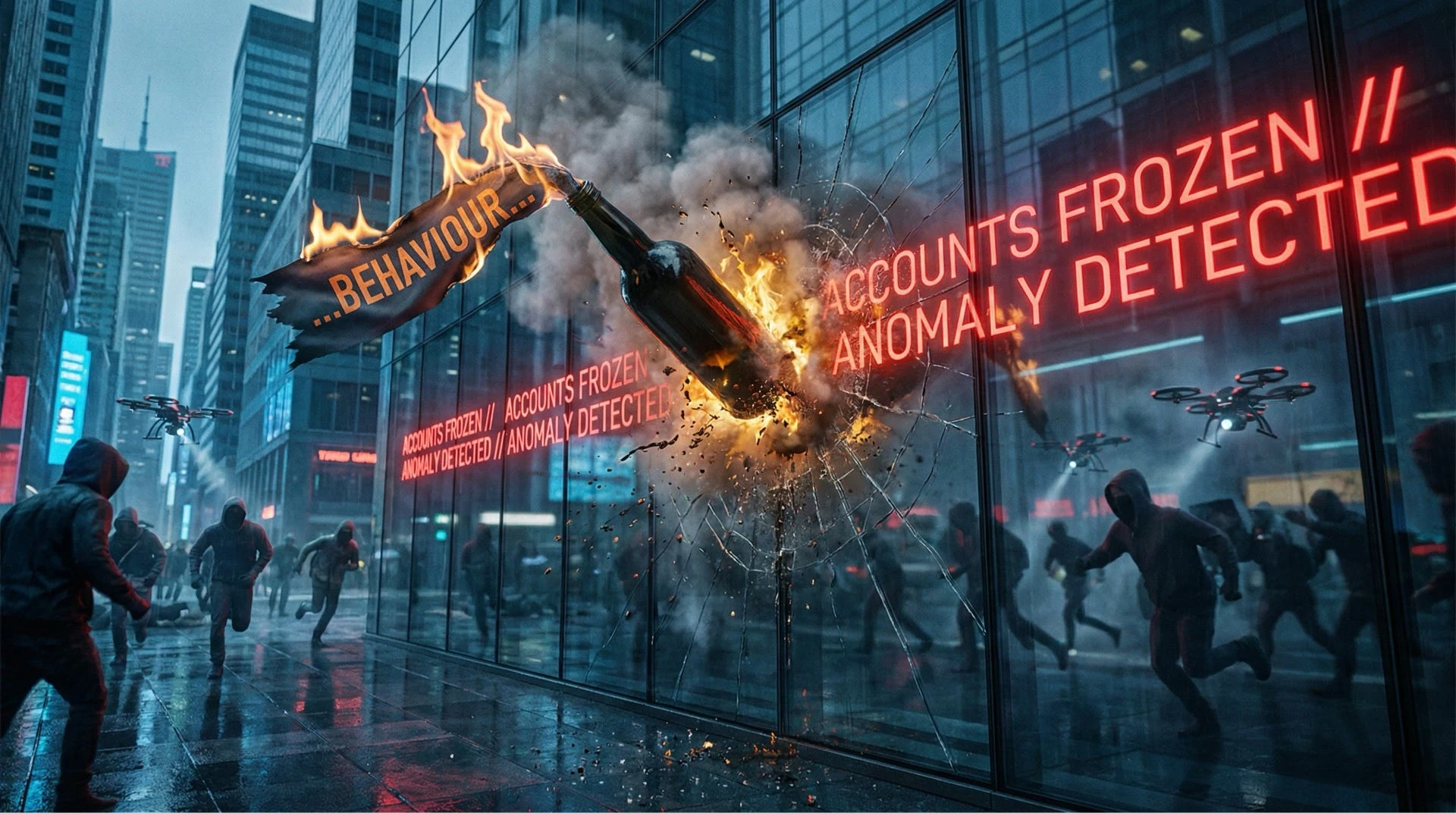
Fourteen hours of financial silence. The city was still there. It simply could not pay.
The staircase from 2018 to 2040.
Each directive looks reasonable in isolation. Read in sequence, they are an architecture. Open each node to read the file.
Strong Customer Authentication frames consumer protection as the rationale. The architectural shift is the systematization of consumer identity at every transaction. Identity becomes a transaction layer.
UPBG is presented as a fraud-prevention layer. In the model, the graph quietly absorbs adjacent functions: tax exposure, charitable patterns, political donation patterns, lifestyle indicators. A single behavioural object built around each citizen.
Kravchenko vanishes after recovering an archive on early UPBG training corpora. The drive surfaces in 2040 through a former bank security chief named Max de Vries inside DFT-21.
The pitch is convenience: faster settlement, lower fees, instant cross-border. The architectural feature is programmability: money that can be told what it is and is not permitted to do.
Cross-jurisdictional risk scoring becomes active. Your transactions are evaluated not only against your own pattern but against the patterns of those you have transacted with. Guilt by adjacency, encoded.
Evidence frame · Brussels · 2037.11.23The official explanation is a routing error. In the model, it is a controlled demonstration. After the blackout, PSD5 is introduced as a "temporary measure".
Introduced as a temporary stabilization measure. The temporary measure is not removed. By 2040 it is the foundation. Your past is editable by authority.
DFT-21 · Deutsche Finanz Tower · sealedThe former Deutsche Finanz Tower in northern Munich is sealed and renamed DFT-21. The interior is a zone. People who enter to recover what was once theirs are called stalkers.
Subject is correlating regulatory cascade across nineteen-year horizon. Subject is flagged.

The ones who go back in to recover what was theirs are called stalkers.
The chapters as recovered.
Eight of sixteen fragments published to date. Each opens on Substack. The remaining eight are completed through the crowdfunding.
"Nothing in the Zone ever happened by accident. That was what the old stalkers said."
"Crisis framing enables accelerated adoption with limited public scrutiny."
"Transaction blocked. Anomaly pattern detected."
"God at least lets you confess before execution. The algorithm just writes 'transaction declined'."
"Müller, Jamie. Rating: 847. Status: moderate anomaly. Recommendation: observe."
"There was no revolution. There was comfort. And a very, very slow boiling of water."
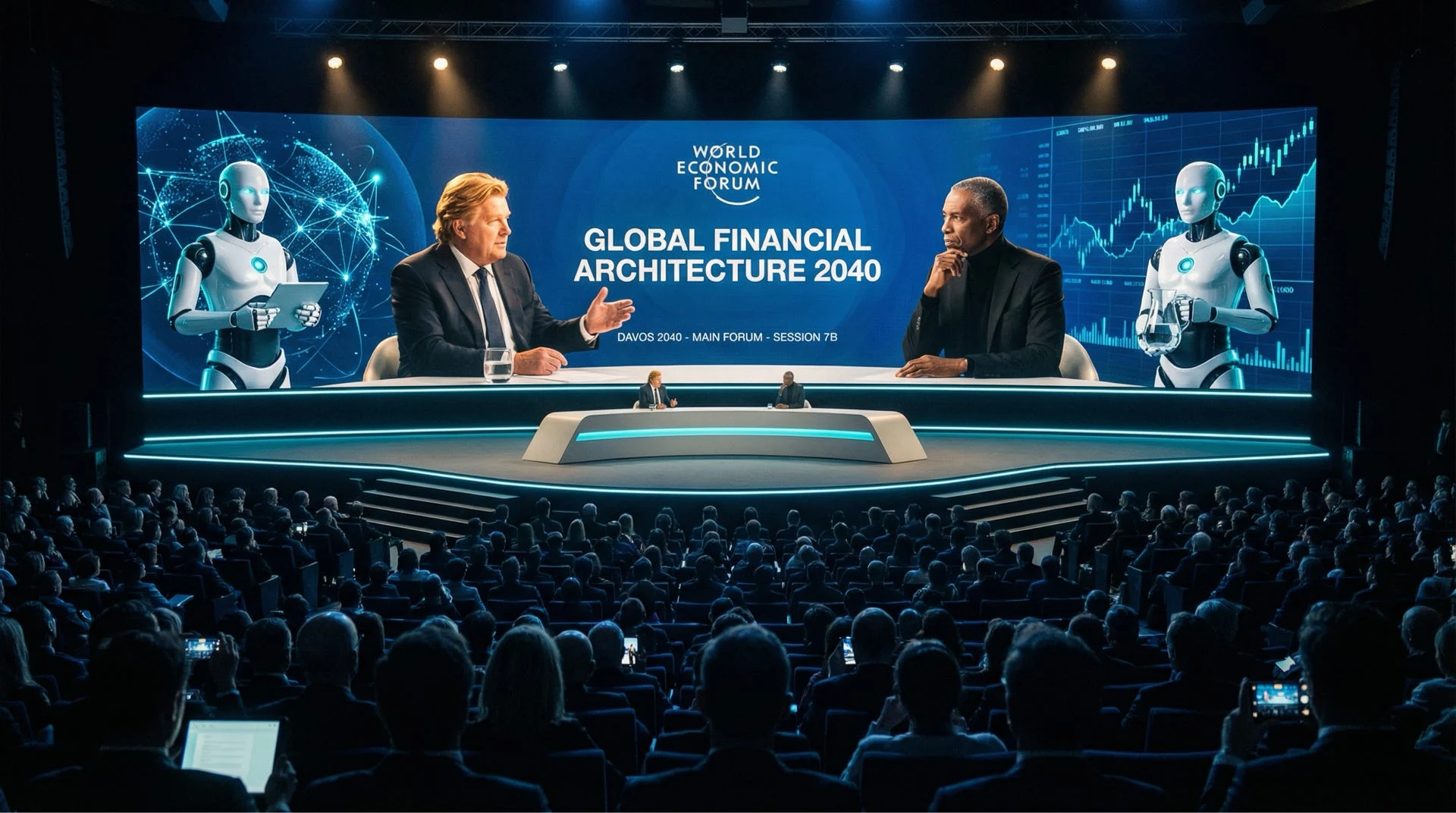
"Cocaine is at least honest about what it does. Davos is not."
"An underground EMI that breaks its contract is a dead underground EMI. Not morality. Just a business model."
The second half of the model. Released as the crowdfunding completes the book.
Subject has accessed recovered DFT-21 fragments. The dead journalist's files are visible to subject.
Seven independent observations.
Statements intercepted from Substack-network observers. All sources verifiable. Select a subject to open the full record.
Seven additional subjects have filed corresponding observations. Source network mapping active.
The author writes from inside what she describes.
Subject is now in possession of source publication identifier. M. Agius added to monitored entities. The system will remember this visit.
The first chapter is free. Start there.
Eight chapters are live on Substack, comments open, no paywall. Read one and decide whether the model holds.